
10 Government Schemes Pakistani Farmers Should Know About in 2026 — and How to Apply
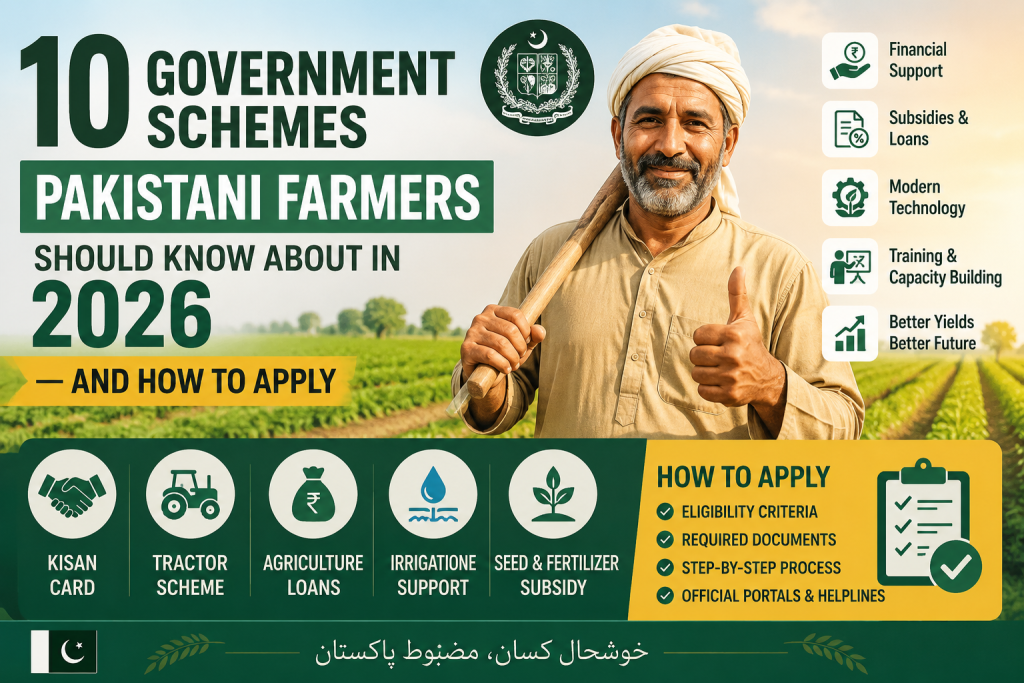
Pakistan’s agricultural sector employs nearly 40 percent of the country’s workforce and contributes significantly to GDP. Yet many of the farmers who drive this sector are unaware of the government support schemes available to them — subsidies, loans, training programmes, and equipment grants that could meaningfully improve their livelihoods. This guide covers ten of the most important schemes in 2026 and exactly how to access them.
Why Most Farmers Miss Out on Government Support
The gap between available government agricultural support and farmer awareness of that support is one of the most persistent challenges in Pakistan’s rural development landscape. Schemes are announced, funds are allocated, and application portals go live — but in rural areas, where internet access is limited, literacy levels vary, and trust in government processes is cautious, uptake consistently falls below targets.
The result is that the farmers who most need support are often the ones least likely to receive it — not because they are ineligible, but because they don’t know the scheme exists, don’t know how to apply, or encounter the application process and find it too confusing to complete without guidance.
This guide is designed to close that gap. It covers ten schemes that are active or newly launched in 2026, explains what each one offers, who is eligible, and how to apply — with practical guidance on the digital tools that make the process easier.
1. Apna Khet Apna Rozgar Scheme 2026
What it offers: Apna Khet Apna Rozgar is one of the most significant agricultural support schemes launched for Pakistani farmers in recent years. The scheme provides financial assistance, agricultural inputs, and employment support to small and subsistence farmers — with the specific goal of increasing productivity on smallholdings and creating rural employment opportunities tied to agricultural activity.
The scheme targets farmers who own or cultivate small plots and lack the capital to invest in better seed varieties, fertiliser, irrigation improvements, or basic agricultural equipment. Approved applicants receive support packages tailored to their specific agricultural context.
Who is eligible: Pakistani citizens engaged in farming or agricultural activity, with priority given to small landholders, subsistence farmers, and those in rural areas with limited access to commercial credit.
How to apply: Applications for Apna Khet Apna Rozgar 2026 are accepted online through the official scheme portal. The online application requires your CNIC number, basic personal information, details of the land you farm (owned or leased), your crop or livestock activity, and supporting documentation where applicable.
Step by step:
- Visit the official portal and select “Apply Online”
- Register with your CNIC number and mobile number
- Complete the application form with your farming details
- Upload required documents — CNIC copy, land ownership or lease documentation, and any supporting agricultural records
- Submit and note your application reference number for follow-up
After approval: Scheme materials, inputs, and equipment are typically dispatched via courier to your registered address. Keep your TCS or Leopard tracking tools ready — many rural deliveries under government schemes use these networks and tracking your delivery status ensures you don’t miss it.
Important: Only apply through the official portal. Beware of third-party websites or agents claiming to process applications for a fee — the official application is free.
2. Prime Minister’s Kissan Package
What it offers: The PM Kissan Package provides direct financial support and input subsidies to Pakistani farmers, covering subsidised fertiliser, certified seed provision, and agricultural credit access. It has been one of the flagship agricultural support mechanisms in recent years and continues to operate in updated form in 2026.
Who is eligible: Registered farmers across Pakistan, with subsidy amounts and eligibility criteria varying by province and crop type.
How to apply: Registration is handled through the Agriculture Department of your relevant province. Applications can be initiated through provincial agriculture department offices, registered Kissan Cards (where issued), and in many areas through the Pakistan Agriculture Coalition’s digital registration portals.
Practical tip: If you are already registered for the Kissan Card scheme, many PM Kissan Package benefits are accessible through the same registration. Check with your local agriculture extension officer for the most current application pathway in your district.
3. Kissan Card Programme
What it offers: The Kissan Card is a government-issued payment card that gives registered farmers direct access to agricultural subsidies — covering fertiliser, certified seeds, pesticides, and in some provinces, fuel for agricultural machinery. The card works at registered agricultural input dealers, removing the middlemen and leakages that have historically reduced the value reaching farmers.
Who is eligible: Farmers across Pakistan who are registered with provincial land records and can provide CNIC documentation confirming their farming activity.
How to apply: Applications are processed through provincial Agriculture Departments and their partner financial institutions. In Punjab, the Punjab Agriculture Department handles registration through its dedicated portal and field offices. In Sindh and KPK, equivalent provincial agriculture departments manage the programme.
Key benefit: The Kissan Card significantly reduces the documentation burden compared to traditional agricultural loan applications, making it one of the most accessible entry points into government agricultural support for farmers who have not previously engaged with formal financial systems.
4. Zarai Taraqiati Bank Limited (ZTBL) Agricultural Loans
What it offers: ZTBL is Pakistan’s primary agricultural development bank, offering loans specifically designed for farming needs — crop production loans, farm machinery loans, livestock loans, and land improvement financing. Interest rates are subsidised relative to commercial bank rates, and repayment schedules are structured around agricultural cycles.
Who is eligible: Farmers with land ownership documentation or verifiable tenancy arrangements. ZTBL has branches across rural Pakistan specifically to serve farming communities.
How to apply: Visit your nearest ZTBL branch with your CNIC, land records (Fard Malkiyat or tenancy documentation), and a description of the agricultural purpose for the loan. ZTBL loan officers conduct field verification before approval.
Loan types available:
- Production loans for seed, fertiliser, and pesticide costs
- Development loans for irrigation, land levelling, and infrastructure
- Livestock loans for cattle, poultry, and dairy operations
- Farm mechanisation loans for tractors and equipment
5. National Agricultural Technology Programme (NATP)
What it offers: NATP is a long-running programme focused on improving agricultural productivity through technology transfer, farmer training, and demonstration farm programmes. It provides smallholder farmers with access to improved farming practices, better seed varieties, and technical knowledge that increases yields without requiring large capital investment.
Who is eligible: Smallholder farmers in targeted districts across Pakistan. Programme availability varies by district and crop focus area.
How to apply: Contact your local Agriculture Extension Department office. NATP operates through district-level field teams who register participating farmers and provide training at farm level. The application process is largely offline and facilitated by extension workers.
6. Solar Tube Well Scheme
What it offers: The Solar Tube Well Scheme provides subsidised or zero-cost solar-powered irrigation systems to farmers in areas where electricity supply is unreliable or unavailable. Replacing diesel-powered or electrically dependent tube wells with solar systems reduces the single largest recurring cost for many irrigated farms — fuel and electricity for water pumping.
Who is eligible: Farmers in eligible districts, prioritising those in areas with high electricity load shedding and those currently using expensive diesel pumping systems.
How to apply: Applications are processed through provincial Energy Departments and Agriculture Departments jointly. Check with your local district administration for current programme availability in your area, as scheme rollout has been phased by district across provinces.
7. Punjab Agriculture Transformation Programme (PATP)
What it offers: PATP is a large-scale agricultural modernisation programme focused on transitioning Punjab’s farming sector toward higher-value crops, improved water use efficiency, and better market linkages. The programme offers subsidies on drip irrigation systems, tunnel farming equipment, and training in modern agricultural practices.
Who is eligible: Farmers in Punjab province with smallholdings who are willing to transition toward high-value crops or adopt water-saving irrigation technologies.
How to apply: Applications are handled through the Punjab Agriculture Department’s district offices. Online registration is available through the Punjab Agriculture Department portal for some components of the programme.
8. Livestock and Dairy Development Board (LDDB) Support Schemes
What it offers: The LDDB administers multiple support programmes for Pakistan’s livestock sector — covering dairy cattle improvement, poultry development, and small ruminant (sheep and goat) programmes. Support includes subsidised veterinary services, improved breed access, and training in livestock management.
Who is eligible: Livestock farmers across Pakistan, with specific programmes varying by province and livestock type.
How to apply: Contact the LDDB office in your province or visit the Livestock and Dairy Development Department at district level. Many programmes have simplified application processes designed to be accessible to farmers with limited documentation.
9. Crop Insurance Programme (Fasal Bima)
What it offers: Pakistan’s Fasal Bima (crop insurance) programme provides subsidised insurance coverage for major crops including wheat, rice, cotton, sugarcane, and maize. In the event of crop loss due to natural disasters, drought, flooding, or pest damage, insured farmers receive compensation that helps them recover without falling into debt.
Who is eligible: Farmers growing insured crops in participating districts. Insurance premiums are heavily subsidised by the government, making the scheme accessible to smallholders.
How to apply: Registration for Fasal Bima is handled through partner banks — particularly Zarai Taraqiati Bank and National Bank of Pakistan — and through Agriculture Department field offices at the time of seasonal crop registration.
Why this matters: Pakistan’s agricultural sector is among the most climate-vulnerable in Asia. With increasing frequency of extreme weather events, crop insurance is no longer optional risk management for farmers who want to protect their livelihoods.
10. Youth Agri-Entrepreneurship Programme
What it offers: Targeting Pakistan’s rural youth, this programme provides business development training, startup funding, and mentorship for young people wanting to establish agriculture-related enterprises — including value-added food processing, agricultural input supply, farm equipment services, and rural e-commerce.
Who is eligible: Pakistani citizens between 18 and 35 years of age with interest in agricultural entrepreneurship.
How to apply: Applications are managed through the National Vocational and Technical Training Commission (NAVTTC) and provincial Small and Medium Enterprises Development Authority (SMEDA) offices. Both organisations maintain online portals where applications can be initiated.
The Digital Tools That Make Government Schemes More Accessible
Navigating Pakistan’s agricultural support ecosystem is significantly easier with the right digital tools in your hands. Two tools in particular are practically essential for farmers engaging with government schemes in 2026.
Track My Train — For Travelling to Provincial and District Offices
Many government scheme application and verification processes require in-person visits to district or provincial offices — for document verification, field assessments, or collecting approved materials. For farmers in rural areas who travel by Pakistan Railways, knowing your train’s real-time status before you leave saves wasted trips and missed appointments.
Track My Train shows the live position of any Pakistan Railways train, how far ahead or behind schedule it is running, and when it will reach your station. Check it before you leave home, not after you’re already on your way to the station.
Practical use: Before travelling to Lahore, Karachi, Islamabad, or any provincial capital for scheme-related appointments, check your train status at least one hour before departure. A two-hour delay is far easier to manage at home than at the station.
Courier Tracking — For Managing Scheme Deliveries
Once a government scheme application is approved, materials, equipment, and documentation are often dispatched via Pakistan’s major courier networks. Approved Apna Khet Apna Rozgar packages, Kissan Card deliveries, and agricultural input consignments from government programmes regularly move through TCS and Leopard Courier networks to reach farmers at their registered addresses.
Keeping both TCS Track and Leopard Track bookmarked on your phone means you can check the status of any government scheme delivery instantly — knowing when it’s dispatched, where it currently is, and when to expect it at your door.
Avoiding Common Application Mistakes
Across all ten schemes above, the same mistakes repeatedly cause applications to be delayed or rejected:
Incomplete documentation. The most common rejection reason. Before submitting any application, confirm every required document is included — CNIC, land records, and any scheme-specific requirements. Make clear copies of all documents before submission.
Using unofficial portals or agents. For online schemes, always use the official government portal. Third-party websites that offer to process applications for a fee are almost always either scams or unnecessary — legitimate scheme applications are free and designed to be completed directly.
Incorrect CNIC information. Your CNIC number must match exactly across all documents. Any discrepancy causes immediate verification failure.
Missing the application window. Most schemes have defined application periods. Note the opening and closing dates for any scheme you intend to apply for and submit well before the deadline — not on the final day.
Not saving your reference number. Every submitted application generates a reference or tracking number. Save it immediately. This is the only way to follow up on your application status if there are delays.
A Final Word
Pakistan’s government agricultural support ecosystem is larger and more accessible than most farmers realise. The ten schemes in this guide represent billions of rupees in available support — subsidies, loans, training, insurance, and equipment — that goes underutilised every year because eligible farmers don’t know how to access it.
The application processes have become significantly more digital in 2026. The official Apna Khet Apna Rozgar portal, provincial agriculture department websites, and partner bank applications can all be initiated online, reducing the need for multiple in-person visits that cost time and travel expense.
Use the tools in this guide. Apply for the schemes you qualify for. And share this article with any farmer in your family or community who might benefit from knowing these programmes exist.
Are you currently applying for any of these schemes? Share your experience in the comments — and if there’s a government agricultural programme that should be on this list, let us know.