
How Crochet Creators Can Use Instagram to Showcase Their Work and Grow an Audience

Crochet is naturally made for visual platforms. Colorful yarn, visible stitch texture, work-in-progress transformations, and cute finished projects can capture attention before someone even reads a caption.
For crochet pattern designers and small handmade businesses, Instagram can be more than a place to collect likes. A well-planned Reel, carousel, or Story can introduce a project, answer potential buyer questions, and guide interested crocheters toward an Etsy shop.
The important part is knowing how to turn one crochet project into content people actually want to watch.
A project such as this Frog Tote Bag Crochet Pattern is a good example. The finished item is visually unusual, but the content possibilities go beyond simply posting a photograph of the bag.
The same applies to smaller projects such as this Crochet Frog Amigurumi Pattern. Its size, long legs, handmade texture, and personality can each become a different Instagram content angle.
Here is how crochet creators can showcase projects more effectively and build content around the actual making process.
Start With the Finished Crochet Project
Before explaining yarn weight, hook size, or pattern terminology, show the finished item.
The finished project is usually the strongest visual hook.
Someone scrolling Instagram may not immediately care that a pattern uses a 3 mm crochet hook. However, they may stop when they see a large green frog that turns out to be a functional tote bag.

The creator has not explained the entire product yet. Instead, the visual creates curiosity.
Once someone is interested in the finished result, details about the pattern become much more relevant.
Turn One Crochet Pattern Into Multiple Posts
One completed crochet project should not automatically mean one Instagram post.
The making process already contains multiple content ideas.
A crochet bag can produce content about the yarn, stitches, base construction, straps, facial details, lining, finished size, pattern pages, and final styling.
Instead of publishing the same product photograph repeatedly, change the content angle.
For example, one Frog Tote Bag project could become a finished bag Reel, a close-up stitch video, a lining demonstration, a “40 step-by-step photos” carousel, a beginner skills post, and a Story showing the pattern languages.
The product stays the same, but each post answers a different question.
This approach is especially useful for independent crochet designers who cannot release a new pattern every few days.
Creating more content does not always require creating more products.
Use Reels to Show Movement
Video can communicate details that are difficult to show in a static photograph.
A crochet tote can be lifted by its straps, opened to reveal the interior, or filled with books and market items. An amigurumi frog can be held in a hand to show its actual size.
Crochet Reels also do not need complicated editing.
A simple video structure can work well:
Show the most interesting detail first. Reveal the full finished project. Add two or three close-up clips. End with a question or simple pattern message.
Possible hooks include “I turned a frog into a tote bag,” “Would you crochet this?” or “40 step-by-step photos later…”
Avoid spending the first few seconds on a logo animation. The crochet project should be visible immediately.
The product itself is the visual hook.
Show That the Finished Project Is Real
Trust matters when selling digital crochet patterns.
Potential buyers may wonder whether the finished project looks like the listing photographs or whether the design is practical outside a styled image.
Real project content helps answer those concerns.
If a bag has an optional lining, show it.
Open the bag on camera or photograph the finished project in a way that makes the fabric visible. A short overlay such as “Fully lined inside” communicates the feature quickly.
The same principle applies to other crochet projects.
If a bag is roomy, show books inside it. If an amigurumi is small, hold it in a hand. If a garment has an adjustable feature, demonstrate how it works.
Show the feature instead of relying entirely on written claims.
Make the Digital Pattern Visible
A PDF crochet pattern is an invisible product until the buyer downloads it.
That means pattern creators should find ways to show what the buyer receives without revealing the complete instructions.
Selected pattern pages can be useful content.
Show the materials page, a pattern cover, examples of step-by-step photographs, or a quick page-flipping video. Important instructions can be cropped or partially hidden where necessary.
If a pattern contains 40 process photographs, that is a strong content angle.
A carousel could begin with the finished project and then show several examples of the visual guidance included in the PDF.
The first slide might say:
“40 Step-by-Step Photos.”
The next slides can show selected construction stages.
This addresses an important buyer concern: “Will I be able to follow this pattern?”
For confident beginners, visual guidance may be one of the strongest reasons to click through and learn more.
Create Posts Around Buyer Questions
Many useful Instagram posts are hidden inside questions customers already ask.
Is this pattern beginner friendly?
What stitches do I need?
What yarn should I use?
How large is the finished item?
Does the PDF include photos?
What crochet terminology is used?
Which languages are available?
Each question can become its own post.
For example, a graphic titled “Great for Confident Beginners” can explain that a pattern uses simple stitches and includes clear written instructions with process photographs.
A different carousel can focus only on the materials required.
This content still promotes the product, but it does so by helping a potential buyer make a decision.
That is usually more useful than repeating “Pattern available now” in every caption.
Use Language Availability as a Content Angle
Pattern language is important for international crochet buyers.
If a crochet PDF is available in English, German, and French, make that information visible.
A simple graphic can display selected pages from all three versions with clear language labels.
This gives the creator another content angle while answering a practical buyer question.
The caption should clearly explain whether all language versions are included in one purchase.
Creators can also experiment with language-focused Stories or posts when promoting a multilingual pattern.
The goal is clarity. A buyer should not need to search through a long description to discover that the pattern is available in their preferred language.
Present Small Amigurumi Differently
A tote bag and a small amigurumi frog should not be photographed in exactly the same way.
Large crochet projects often need lifestyle context. Viewers want to understand their size and practical use.
Small amigurumi benefits from scale and personality.
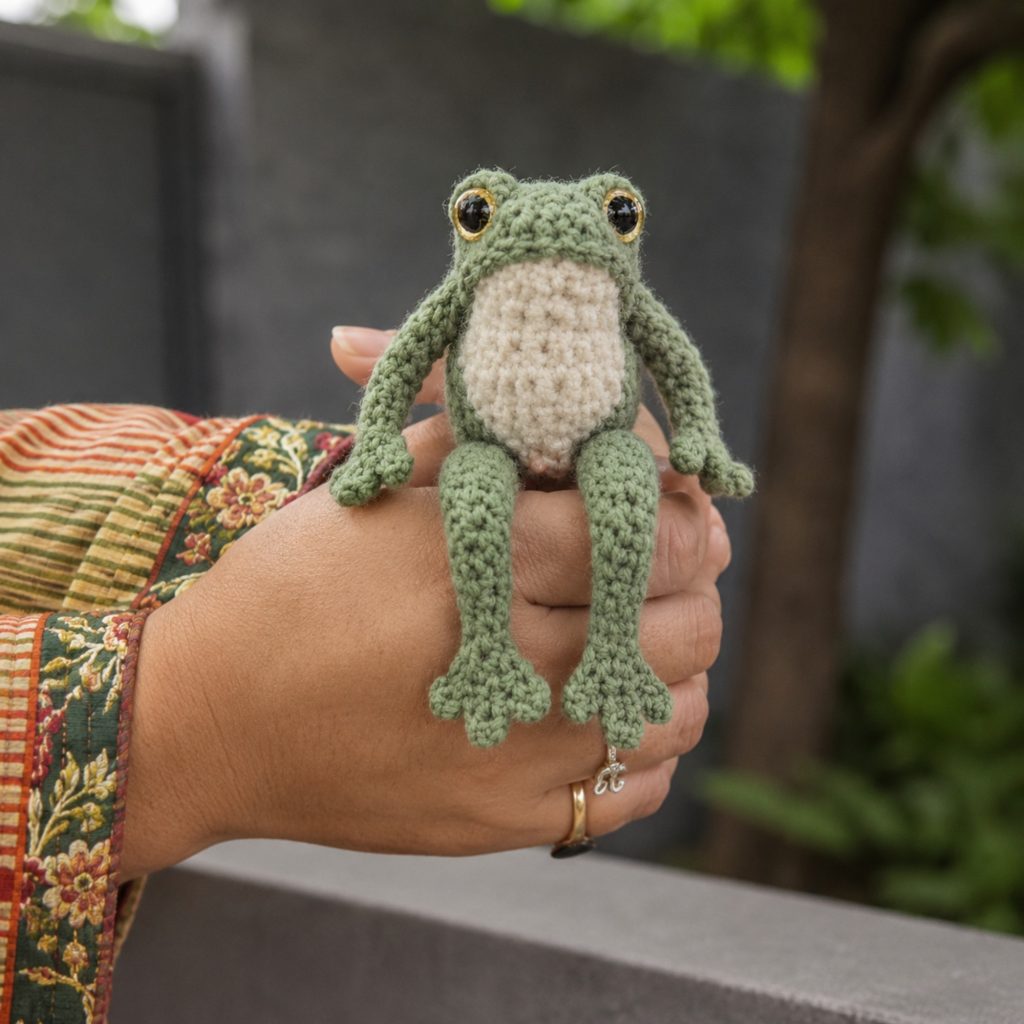
A hand-held photograph instantly shows that the frog is a small project.
For Reels, creators can also build content around the character of the finished amigurumi.
Possible hooks include:
“Meet the tiny frog I finished.”
“His little legs are my favorite part.”
“Would you keep this frog on your desk?”
This feels more natural than opening every video with a sales message.
The pattern can still be mentioned in the caption or at the end of the Reel.
Do Not Make Every Post a Sales Pitch
An Instagram account becomes repetitive when every caption says “new pattern,” “buy now,” and “link in bio.”
Some posts should sell directly. Others should create conversation.
Ask specific questions related to the crochet project.
Would you use this as a market bag or a book bag?
Which frog color should I make next?
Do you prefer written instructions or step-by-step photos?
Would you add a fabric lining?
Specific questions are easier to answer than “What do you think?”
The responses may also help with future product decisions.
If many crocheters ask about skill level, create more beginner-focused content. If people are interested in the lining, make a Reel showing the inside of the bag.
Audience questions can become a content calendar.
Use Instagram Stories During a Pattern Launch
Stories are useful for content that does not need a permanent place on the main grid.
During a pattern launch, a creator can share a simple three-Story sequence.
First, show the finished crochet project.
Next, highlight the strongest pattern feature, such as step-by-step photographs or multiple languages.
Finally, add the product link.
Stories can also be used for polls, work-in-progress photographs, yarn choices, and Reel reshares.
Keep the design simple.
One clear message per Story is usually easier to understand than placing the pattern name, price, materials, skill level, and shop information on one screen.
Create Content People Want to Share
A crochet post may be shared because it is useful, unusual, or reminds someone of a friend.
A frog-shaped tote bag has a natural sharing advantage. Someone who sees it may immediately think of a friend who loves frogs.
Small amigurumi can create the same reaction.
Creators should think about the person on the receiving side of a share.
Who would a viewer send this project to?
A frog collector? A crochet beginner? Someone looking for a cute handmade project?
Useful crochet content can also encourage sharing. Stitch tips, yarn comparisons, finishing ideas, and pattern-reading advice give crocheters a practical reason to send a post to another maker.
Not every shareable post needs to follow a trend.
Sometimes the project itself is interesting enough.
Keep the Path to Etsy Simple
When an Instagram post creates interest, the next step should be obvious.
If the goal is Etsy traffic, keep the shop or product link easy to find.
Use a direct link in Stories when appropriate. Keep the profile link updated. For product-focused Reels, clearly mention where the pattern is available.
Avoid making interested shoppers search manually for the item they just watched.
A person who sees a Frog Tote Bag Reel should be able to quickly reach the matching pattern.
Instagram creates the interest. The link path should reduce unnecessary steps between interest and the product page.
Measure More Than Likes
Likes are visible, but they do not tell the complete story.
Crochet pattern creators should also pay attention to saves, shares, profile activity, link clicks, and genuine pattern questions.
A beautiful photograph may receive many likes but generate little product interest.
A beginner-focused carousel may receive fewer likes but encourage people to visit the pattern listing.
Review content over time.
Do process videos receive more saves? Do unusual finished projects earn more shares? Do pattern preview posts lead to more clicks?
Use those patterns to decide what to create next.
The goal is not to copy every trend. It is to understand what helps the right crochet audience discover and engage with the work.
Final Thoughts
Instagram works well for crochet creators because the craft is already full of visual stories.
A ball of yarn becomes a bag. Separate crochet pieces become a tiny frog. A collection of stitches slowly turns into a finished project someone can hold, wear, or use.
Show that process.
Start with the finished item, create multiple content angles from one pattern, answer buyer questions, demonstrate real features, and make digital pattern benefits visible.
Most importantly, let the crochet work remain the focus.
Creators do not need to invent a completely separate social media identity. The yarn, stitches, mistakes, progress photographs, and finished projects already provide the foundation for useful Instagram content.
One crochet project can tell many stories. Instagram simply gives creators a visual place to share them. 🧶🐸