
Why Most Glute Programs Fail Office Workers and What Actually Helps
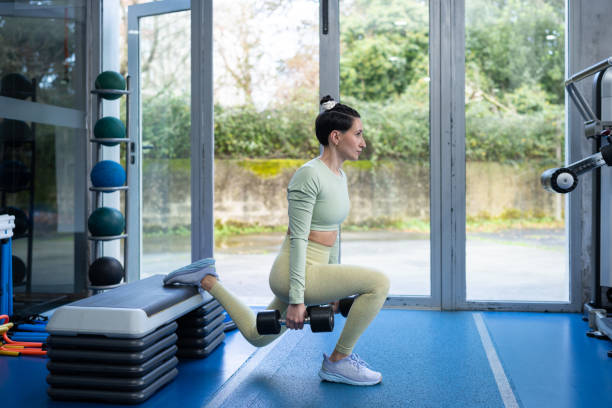
A colleague of mine started a popular glute program she found online last year. Twelve weeks, very structured, lots of barbell work and gym machines. She followed it almost perfectly. By week ten she had knee pain, her lower back was angrier than before she started, and she had not felt her glutes work properly even once during the entire program. She was not doing it wrong. The program just was not designed for someone whose hips had spent eight years in a chair for most of their waking hours. That gap between generic fitness programs and what desk workers actually need is real, and understanding it is what makes a targeted dumbbell glute workout worth seeking out rather than just picking up whatever is trending on social media at a given moment.
The problem with most glute programs is that they assume a baseline level of hip mobility and glute activation that a lot of office workers simply do not have. They jump straight into heavy compound movements without addressing the fundamental issue; that prolonged sitting has already created imbalances that will interfere with every single exercise in the program. You can follow a technically sound program perfectly and still get very little from it if the underlying dysfunction is not addressed first.
The Specific Way Desk Work Breaks the Glutes
Let me give you an example in simple terms since it was hard for me to understand this concept until recently. When sitting down, the hip joints will be locked in a flexed posture, while the hip flexor muscles will be shortened due to their flexion role. The hip extensor muscles, which mostly involve the glutes, will remain lengthened and relaxed. In the long run, the body will think that the hip flexors have priority over the glutes.
The nervous system responds by keeping the hip flexors tight and ready and by reducing the neural signal to the glutes during movement. This is not a conscious process, and it does not happen overnight. It builds up quietly over months and years until one day you try to do a glute bridge and feel almost nothing in the glutes despite having done everything technically correctly. The muscle is there. It is just not listening to the signals anymore.
This is why programs designed for people without this history can fail so thoroughly for desk workers. They load a pattern the body is already compensating around rather than fixing the compensation first.
Activation Work Is Not Optional for People Who Sit All Day
I know activation drills feel like a waste of time. They are not flashy. Nobody posts videos of themselves doing clamshells with a light resistance band. But for office workers starting a glute program, ten minutes of activation work before the main session is probably the highest return investment in the whole workout.
The goal of activation is simple; get the glutes firing before you ask them to produce force under load. A few sets of bodyweight glute bridges, some clamshells, a bit of hip circle work, maybe a quadruped kickback or two. Nothing heavy, nothing intense. Exactly enough motion for waking up the neural link between brain and muscles so that when the dumbbell appears, the glutes will already be in the game and not leave all the hard work to the quads and lower back.
People who skip this step and jump straight into weighted exercises often spend the entire session training the wrong muscles without realizing it. The movement looks like glute training. The muscle working is mostly something else. A ten-minute warmup changes that dramatically.
Choosing Exercises That Work With Your Hip Mobility Rather Than Against It
Deep squats are a good example of an exercise that desk workers often struggle with even though squatting is technically a natural human movement. movement pattern. The issue is hip flexor tightness and limited ankle mobility, both of which develop from prolonged sitting, create restrictions that make it very hard to squat to depth without compensating by rounding the lower back or letting the heels rise. The squat itself is fine. The prerequisites for doing it well are missing.
However, goblet squats are easier due to the fact that the weight is held in front of the body, creating an element of balance, thus allowing one’s torso to remain vertical to a certain degree, thereby placing less strain on the hips. Box squats are those exercises where one lowers oneself back into a seated position on a box before returning to the standing position. This exercise teaches one how to squat correctly without having to squat too low.
The hip hinge exercises such as Romanian deadlifts appear to be easier to perform for those who work from their desks than squats. This is because the hinge exercise does not demand as much hip flexor flexibility as squats do. Besides, the load on the posterior chain muscles becomes noticeable much faster compared to the load on the other muscles. It would be wise to begin with hinges before proceeding with squats.
Single-Leg Work Is Where the Real Gaps Show Up
One thing that catches almost every desk worker off guard when they start serious glute training is how obvious their left-to-right asymmetries become the moment they start doing single-leg exercises. Step-ups, split squats, and single-leg bridges: all of these expose differences between sides that bilateral exercises can hide completely. One glute fires well; the other lags. The one hip joint is free to move, while the other appears sticky and stiff. These imbalances are developed silently through many years of poor posture due to sitting in the same way for long periods of time, sitting with one leg crossed and leaning to one side on an armrest.
The fix is straightforward even if it takes time; prioritize the weaker side slightly. Start each single-leg exercise on the side that feels harder. Give it the same number of sets as the stronger side rather than stopping when the stronger side is done. Over several weeks the gap typically closes. It rarely closes completely, but it narrows enough to stop causing the compensations that lead to pain and injury.
The Lower Back Issue That Keeps Coming Up
Desk workers who start glute training often notice lower back involvement in exercises where they should not be feeling it. Hip thrusts that light up the lower back instead of the glutes. Romanian deadlifts that create spinal tension rather than hamstring stretch. This is a form issue almost every time, specifically around anterior pelvic tilt and lumbar overextension, but it is also a symptom of the glutes not doing their job and the lower back muscles compensating.
Cueing a posterior pelvic tilt before loading any exercise helps enormously. Before starting a set of hip thrusts, tuck the pelvis slightly, imagine flattening out the lower back curve, and hold that position as you move. It feels restrictive at first because it is the opposite of the anterior tilt most desk workers carry all day. But it puts the glutes in a position where they can actually contract fully, and it takes the lower back out of the equation in a way that makes the exercise feel completely different.
What a Realistic Week of Training Looks Like
Two sessions per week for the first month. That is it. Not because more would not work in theory, but because the adaptation process for someone whose glutes have been dormant for years includes a recovery component that people consistently underestimate. However, the muscles are also establishing the movement patterns again and taking care of any immobility issues and dealing with pain, which can be considerable in the early weeks. Just two classes spaced correctly will help them make considerable progress without causing too much pain to make life difficult.
Typically, a training session follows a certain format. This would be ten minutes of hip flexor stretching, followed by four movements, such as a hinge, either a squat or split squat, a hip thrust, and an isolation movement like a kickback or lateral lunge. The exercises are done three times each. Done in thirty to forty minutes. That is a complete and effective session for someone building from scratch, and it fits into most people’s evenings without requiring any real sacrifice of time.
For a full breakdown of which exercises to use at each stage and how to structure progression across weeks, the 15 Best Glute Exercises resource from My Exercise Snacks covers both the exercise selection and the programming logic behind it in a way that is practical for home training rather than assuming gym access.
The Mindset Shift That Actually Makes It Work Long Term
Most people approach glute training as an aesthetic goal with a finish line somewhere. Get to a certain point, look a certain way, and then what, stop training? The people who see the best long-term results are the ones who eventually stop thinking about it as a project and start thinking about it as maintenance. The glutes need regular loading the same way a car needs regular fuel. You do not fill the tank once and expect it to run indefinitely.
For desk workers specifically, this reframe matters more than it does for people with more active lifestyles. The sitting is not going away. The job is not changing. The hours at the computer are a fixed feature of life for most people in this situation. Which means the training has to be a fixed feature too; not a temporary intervention until things improve, but an ongoing part of the week that addresses an ongoing physical reality. That is a less exciting framing than a twelve-week transformation program. It is also a far more honest and ultimately more useful one.