
How Heavy Equipment Fleets Are Moving Away from Desktop-Era CMMS
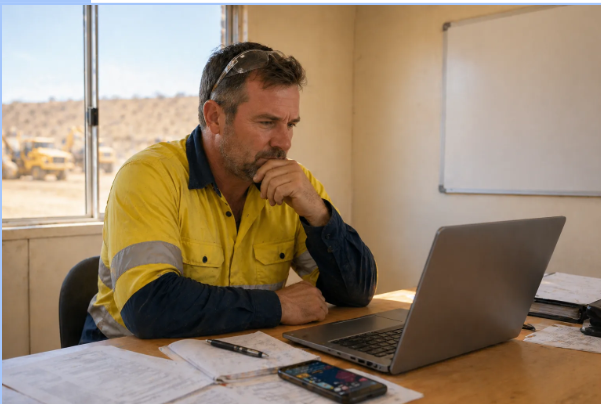
Heavy equipment fleets across Australia are moving away from desktop-era CMMS. See why the shift is happening and what modern maintenance systems offer instead.
There is a quiet shift happening across Australian earthmoving and heavy equipment businesses.
It is not sudden. It does not make headlines. But it is consistent. Businesses that built their maintenance processes around desktop-based systems are reaching a point where those systems no longer match how their operations actually run.
The trigger is rarely a single dramatic failure. It is usually a slow accumulation of friction. Reports that take too long to compile. Records that do not reflect what happened in the field. Supervisors who spend more time chasing information than acting on it.
At some point, the gap between what the system shows and what is actually happening becomes too wide to manage. And that is when the conversation about replacing the system begins in earnest.
The systems that worked well for a single workshop ten years ago were not built for fleets operating across four projects with contractors servicing machines in the field.
What Desktop-Era CMMS Was Built For
It is worth understanding where desktop-era maintenance systems came from, because their limitations make more sense in that context.
Most of the CMMS platforms that became standard in Australian heavy equipment operations were built at a time when maintenance management meant one central workshop, a dedicated maintenance coordinator, and a relatively predictable fleet operating from a fixed base.
In that environment, desktop-first design made perfect sense. The coordinator sat at a desk. Records were entered at the end of each shift. Reports were run weekly. The system worked because the information flow was manageable and centralized.
That model still exists. But it represents a smaller and smaller proportion of how earthmoving businesses actually operate today.
How Operations Have Changed
Modern earthmoving and civil contracting operations look very different from the workshop-first model those systems were designed around.
Machines move constantly between projects. A single fleet might have equipment operating across four or five sites at the same time. Fitters travel between locations. Contractors handle scheduled servicing on remote sites. Wet hire arrangements create additional servicing responsibilities that sit outside the traditional workshop structure.
Management still needs visibility across all of it. What is running? What is down? What servicing is due this week. What a breakdown on a remote site is going to cost and how long it will take to resolve.
In a desktop-first system, that visibility depends entirely on people entering information consistently across multiple locations. As operations grow more distributed, that becomes progressively harder to maintain.
Information starts arriving late. Records become incomplete. The gap between the system and reality widens. And the reports that management relies on to make decisions become less and less trustworthy.
The Data Quality Problem
The most serious consequence of desktop-era workflows in a distributed operation is not the inconvenience. It is the data quality.
When maintenance information is captured after the fact, by memory, from incomplete notes, it is almost always less accurate than information captured at the moment the work happens.
Details get left out. Hours get estimated rather than recorded precisely. Component notes do not make it into the system. Breakdown causes get simplified or missed entirely. Over time, the maintenance history for a machine becomes a rough approximation rather than an accurate record.
That matters when it comes to planning. It matters when it comes to calculating true maintenance cost. It matters when a machine is showing symptoms and the maintenance history is the primary tool for diagnosing the cause.
Decisions made on inaccurate data are not just less effective. They can be genuinely costly. A component that should have been rebuilt gets pushed past its useful life because the hours were not tracked properly. A machine that was showing warning signs does not get flagged because the inspection records were incomplete.
Heavy equipment maintenance software that captures data at the source rather than relying on after-the-fact entry changes this dynamic entirely.
Why the Mobile Shift Changes Everything
The move from desktop-first to mobile-first maintenance systems is not just a convenience upgrade. It is a fundamental change in where and when maintenance information enters the system.
In a mobile-first workflow, the fitter records the job from the device in their pocket, while they are still at the machine. The service record is created as the work happens. The parts are logged against the job in real time. The inspection is completed on the mobile device before the machine starts its shift.
The information does not have to travel through a coordinator, a paper docket, or a manual data entry process before it is visible to management. It is in the system immediately, accurately, and completely.
That changes the quality of everything downstream. Planning becomes more reliable. Cost tracking becomes more accurate. Downtime analysis becomes more meaningful. And the maintenance history that builds up over time actually reflects what happened rather than what someone remembered happening.
The Adoption Problem with Legacy Systems
One of the most consistent complaints about desktop-era maintenance systems in field operations is crew adoption.
Fitters and operators are practical people. They are focused on getting machines running and keeping them that way. When a maintenance system adds significant administrative overhead to that job, they will find ways to minimise their interaction with it.
That might mean logging simplified records instead of detailed ones. It might mean batching entries at the end of a shift rather than capturing them as the work happens. In some cases it means avoiding the system almost entirely and leaving the data entry to someone else.
The result is a system that is technically in use but practically unreliable. The records are there, but they do not tell the full story.
This is not a discipline problem. It is a design problem. Systems that were built for administrators rather than field workers naturally create friction for field workers. And friction leads to workarounds.
Samurai CMMS was designed around reducing that friction for the people who do the work. The workflows are built for fitters and operators, not coordinators. The mobile experience is the primary experience, not a secondary one. And the system is designed to fit into the job rather than add to it.
What the Transition Actually Looks Like
For businesses considering moving away from a legacy desktop system, the transition question is usually about risk. Years of service history, component records, and operational processes are tied up in the existing system. Moving away from it feels like a significant undertaking.
That concern is reasonable. But it is worth separating the value of the historical data from the value of the system that holds it.
The historical records have genuine value. They tell the story of how each machine has been maintained over time. That history can be migrated, preserved, and referenced in a new system.
The system itself is just the container. And if the container is no longer fit for purpose, changing it does not destroy the history it holds. It just moves it somewhere more useful.
For businesses that have watched their maintenance data quality decline as their operations grew, the transition to a modern alternative to MEX is less about losing something and more about recovering operational control they have gradually been losing.
Where the Industry Is Heading
The businesses moving away from desktop-era CMMS are not doing it because they are chasing the latest technology trend.
They are doing it because the gap between their current system and their current operation has become a practical problem that affects planning, cost control, and the reliability of the information they use to run the business.
The shift toward mobile-first, field-built maintenance systems is a response to a real operational need. And as earthmoving and civil contracting operations continue to grow more distributed and more complex, that need is only going to become more pressing.
Samurai maintenance software was built specifically for that environment. Not as a generic upgrade, but as a maintenance system designed around how heavy equipment fleets actually operate today.
For businesses that have outgrown their current system, that is a meaningful difference.
See how Samurai works on a real earthmoving fleet.