
One Pair of Dumbbells and a Serious Leg Workout: What I Learned Training at Home
A few years back I bought a pair of dumbbells in a mild panic. It was one of those moments where I looked at my legs in the mirror and genuinely could not remember the last time I had done anything useful with them. I was working from home, barely leaving the flat, and the only real exercise I was getting was walking to the kitchen and back. So I ordered a pair of adjustable dumbbells, shoved my coffee table out of the way, and stood there in my living room wondering what exactly I was supposed to do next.
What followed was about three months of figuring things out the hard way. Wrong exercises, wrong order, too much too soon, then nothing for two weeks because I was too sore to try again. But somewhere in that messy process I found what actually works, and it turned out to be simpler than I expected. A single pair of dumbbells, the right movements, and some patience is genuinely enough to replace what a leg press machine does and honestly do a few things better. The full breakdown of why that is lives in this leg press alternative guide, but let me share what the dumbbell side of that picture actually looks like in practice.
Why Dumbbells Work So Well for Leg Training
There is a reason people default to machines when they are new to training. Machines feel stable. They tell you where to put your hands, your feet, your body. They remove most of the guesswork. The leg press in particular gives you a fixed path of movement and a backrest that takes care of a lot of the stability work for you.
Dumbbells do the opposite. They ask you to control the weight yourself, which means smaller stabilising muscles have to work alongside the big ones. Your core has to stay engaged. Your hips have to stay level. Your ankles have to manage some balance. At first this feels awkward and kind of humbling because you end up using much lighter weights than you expected. Over time though, that extra demand is exactly what makes dumbbell training so effective. You are not just training the quads and glutes in isolation. You are training the whole system that those muscles are part of.
For desk workers specifically, that matters even more. Years of sitting creates real imbalances between the left and right sides, between the front and back of the body, and between the big muscles and the smaller stabilisers that support them. Dumbbell exercises surface these imbalances and quietly fix them in a way that machine training simply cannot.
The Exercises That Made the Biggest Difference
Dumbbell Goblet Squat
Hold one dumbbell vertically at your chest, both hands cupped around the top end, and squat down slowly. This is probably the exercise I would recommend first to anyone who only has dumbbells and wants to train their legs. The weight at the front of the body acts as a counterbalance that naturally helps you stay more upright through the torso, which is something a lot of desk workers struggle with because sitting all day shortens the hip flexors and makes it harder to stay tall in a squat. Three sets of ten with a weight that makes the last two or three reps feel genuinely earned is a solid starting point.
Dumbbell Romanian Deadlift
Hold a dumbbell in each hand in front of your thighs and hinge forward at the hips, pushing them back as the weights travel down your legs. Keep a slight bend in the knees throughout and stop when you feel a strong stretch in the hamstrings. Then drive the hips forward to return to standing. This is not a back exercise, even though it might feel like one at first. It trains the hamstrings and glutes in hip extension, which is a movement pattern that practically disappears from the body after years of sitting in a chair. Most desk workers are much weaker here than they realise, and fixing that makes a real difference to how the lower back and hips feel day to day.
Dumbbell Bulgarian Split Squat
Hold a dumbbell in each hand, place one foot on a chair behind you, and lower yourself down on the front leg. This is the exercise I am most conflicted about recommending because it is genuinely difficult and most people hate it the first few times. But it is also one of the most effective single-leg exercises available anywhere, with or without a gym. It builds serious quad and glute strength, it forces both sides to work equally rather than letting the stronger side compensate, and it takes up almost no floor space. Start with very light dumbbells or no weight at all until the movement feels controlled.
Dumbbell Reverse Lunge
Hold a dumbbell in each hand, step one foot back, and lower the back knee toward the floor. Push through the front heel to return. Adding dumbbells to a reverse lunge changes the exercise quite significantly even with relatively light weights, because the load in the hands means the core and upper back have to work harder to keep the torso upright. If the front knee is sensitive, keep the stride shorter and focus on keeping the shin as vertical as possible throughout the movement.
Dumbbell Step-Up
Hold a dumbbell in each hand and step up onto a sturdy surface with one leg. The working leg does the lifting, the trailing leg just goes along for the ride. Adding weight to step-ups turns a movement that can feel quite manageable bodyweight into something significantly more demanding, and the single-leg nature of the exercise means you cannot cheat by letting the stronger side take over. Use a surface that puts the working knee at roughly ninety degrees when the foot is planted on top of it.
Dumbbell Sumo Squat
Hold one dumbbell with both hands and let it hang between your legs, feet wider than shoulder width and toes turned out slightly. Squat down, keeping the weight hanging naturally in the centre. The wider stance shifts more of the emphasis toward the inner thighs and glutes compared to a standard squat, and the sumo position tends to be more comfortable for people whose hip anatomy does not suit a narrow squat. This one also works well as a finisher at the end of a session when the legs are already tired.
Buying the dumbbells was the easy part. Showing up for the third session in a row when the novelty had completely worn off, that was the actual investment.
How to Put These Together Without Overcomplicating It
When I first started I made the mistake of trying to do every exercise I had read about in the same session. It was too much, it took too long, and I was so sore the next day that I did not train again for almost two weeks. That is not how this works.
Pick three or four exercises. Do three sets of each. Rest about ninety seconds between sets. That is a complete session and it will take somewhere between twenty-five and thirty-five minutes depending on how you pace it. Done twice a week with a day or two in between, it is enough to build real leg strength over the course of a few months.
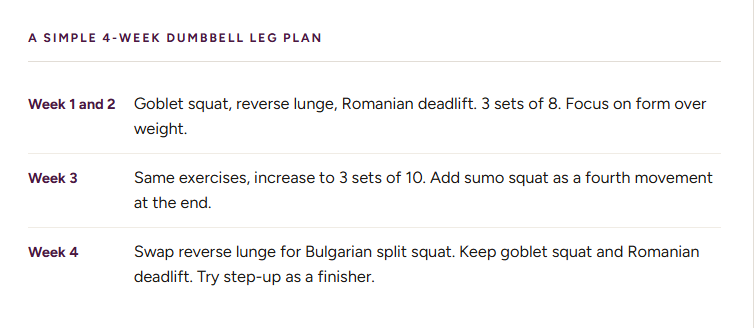
A Simple 4-Week Dumbbell Leg Plan
The Weight Question That Everyone Gets Wrong
People consistently underestimate how light to start and then overestimate how quickly to progress. I have watched people load up heavy for a goblet squat on their first attempt and then wonder why their lower back is sore the next morning. The lower back was sore because the legs were not strong enough to handle the weight yet and the spine ended up compensating.
Start lighter than feels necessary. The first two or three reps of a set should feel almost easy. The last two or three should require real focus and effort. If the whole set feels easy, the weight is too light. If the form breaks down noticeably before the end of the set, the weight is too heavy. Finding that middle ground takes a session or two but once you have it the progression becomes straightforward.
Practical Note
A pair of adjustable dumbbells that go from around 5kg to 25kg will cover almost everything in this article and most of what you will ever need for home leg training. Fixed weight dumbbells work too but you will quickly find yourself needing several different weights as you progress, which gets expensive and takes up more space than most home setups have.
Fitting This Into a Workday That Already Feels Full
The sessions themselves are manageable. What trips people up is fitting them into a schedule that already feels packed. The most honest advice I can give here is to treat the session like a meeting you cannot move. Put it in the calendar, decide in advance which days it happens, and do not negotiate with yourself on the morning of those days about whether you feel like it.
Feeling like training is not a prerequisite for training. I have had sessions where I was tired and grumpy and absolutely did not want to pick up the dumbbells, and I still finished them feeling better than I started. That outcome is almost universal. The body responds to movement regardless of how enthusiastic you were when you started.
Between Sessions
Short movement breaks through the workday matter too. Not for building strength, that is what the sessions are for. But for keeping the hips and legs from locking up through long stretches of sitting. Ten bodyweight squats before lunch, a wall sit during a call, calf raises while waiting for something to load. These small habits make the dumbbell sessions feel more effective because the body is already used to moving regularly.
One pair of dumbbells, a bit of floor space, and twice a week. That is the whole formula. Everything else is just deciding to start and then deciding not to stop.